

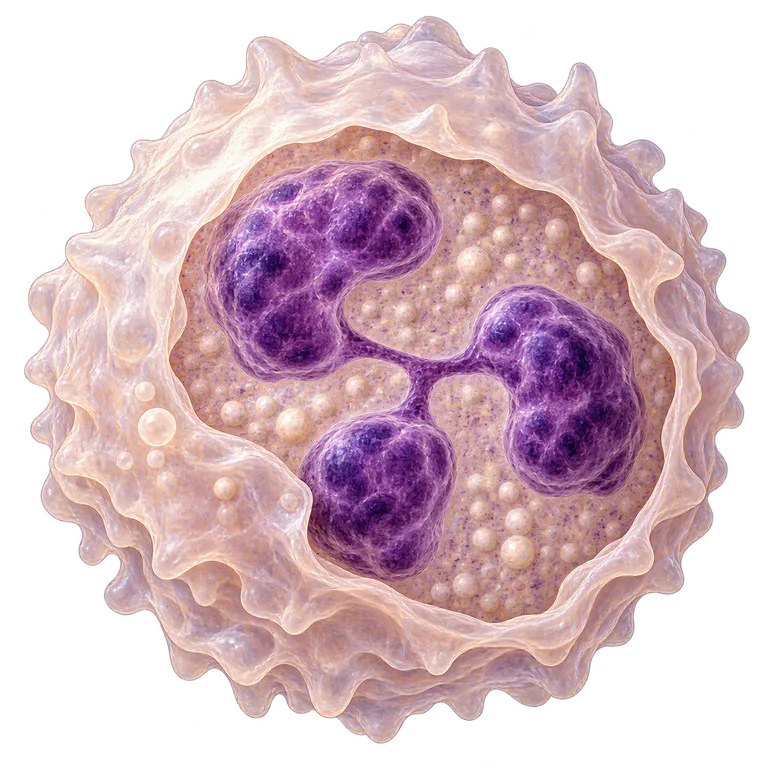
An easy reference to imagine
If this cell were 1 cm in diameter…
The nuclear DNA, unfolded and placed end to end, would reach about 1.67 km. This model uses the reference diameter of 12 µm.
The comparison makes the need for compaction inside the nucleus visible. It does not mean that all cells contain this amount of DNA: gametes are haploid and mature human red blood cells have no nucleus.
How much length do we get by unfolding nuclear DNA?
| Reference | Dimension |
|---|---|
| Nuclear DNA of one cell · unfolded | 2 m Approximate total length: 2 m · thickness illustrative |
| Neutrophil | 12 µm Representative diameter: 12 µm · neutrophil |
Cumulative length ÷ cell diameter: 2 m ÷ 12 µm ≈ 166,700. Cell diameter is not nucleus diameter.
Both illustrations use a common factor for the stated dimension. Positions aid reading and do not represent physical separation.
The 46 molecules do not naturally form a single continuous thread. The scenario concerns nuclear DNA before replication, without counting the double helix’s two strands twice. The 12 µm neutrophil is an example of a nucleated cell, not a universal cell or nucleus size.
Check the conventions
Nuclear DNA of one cell · unfolded
This represents about 2 m of cumulative nuclear DNA length for a diploid human cell before its DNA is replicated. This educational order of magnitude is published by OpenStax: the molecules of the 46 chromosomes are imagined unfolded and placed end to end. They do not naturally form one continuous molecule. This length is not doubled to count the two strands of each double helix separately. The catalogue's 12 µm neutrophil provides a concrete example of a nucleated cell; its diameter is not the diameter of its nucleus, and not all human cells have this size. DNA is compacted inside the nucleus. This scenario excludes mitochondrial DNA, haploid gametes and mature human red blood cells, which have no nucleus. A cell contains more DNA after replication. In the drawing, only the cumulative length is to scale: thickness and molecular details are enlarged to remain visible.
A rounded value that depends on genomic content; there is no exact universal length for all cells. Ploidy, replication and individual characteristics change the amount of DNA. The molecules are conceptually placed end to end without adding connecting lengths; the illustrated thickness is not the actual diameter of the double helix.
Neutrophil
A neutrophil is a specific type of human white blood cell with a lobed nucleus. OpenStax places its diameter at around 10 to 12 µm; this reference adopts 12 µm for the whole cell. This is not the average size of all human cells or the diameter of the nucleus. The DNA comparison conceptually unfolds the diploid nuclear contents before replication; mature red blood cells, which have no nucleus, are not part of this scenario.
Representative diameter chosen from the source's descriptive range of 10 to 12 µm, not a statistical confidence interval. Cell type, state and preparation affect the observed sizes.
Choose another reference
Keep a common factor to compare both dimensions, or open a clearly identified close-up at a different scale.