
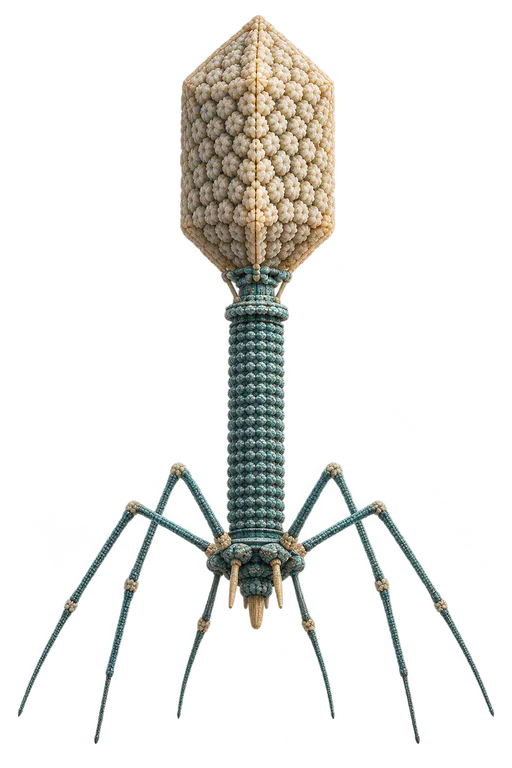

What is the size difference between a virus and a bacterium?
| Reference | Dimension |
|---|---|
| Bacteriophage T4 | 200 nm approximate length |
| Escherichia coli | 2 µm Representative length |
Calculation: 2 µm ÷ 200 nm, after conversion into the same unit. The ratio calculated from the catalogue data is about 10.
Both illustrations use a common factor for the stated dimension. Positions aid reading and do not represent physical separation.
Check the conventions
Bacteriophage T4
A head and tail allow this virus to infect certain bacteria. Displayed dimension: approximate length.
Catalogue value to check against the source; not individually audited.
Escherichia coli
A rod-shaped bacterium whose size depends on its growth conditions. Displayed dimension: representative length.
Catalogue value to check against the source; not individually audited.
Choose another reference
Replace an object in the explorer, keep the common scale factor and try predicting the new ratio before reading it.
Open the comparison →