
What does this number measure?
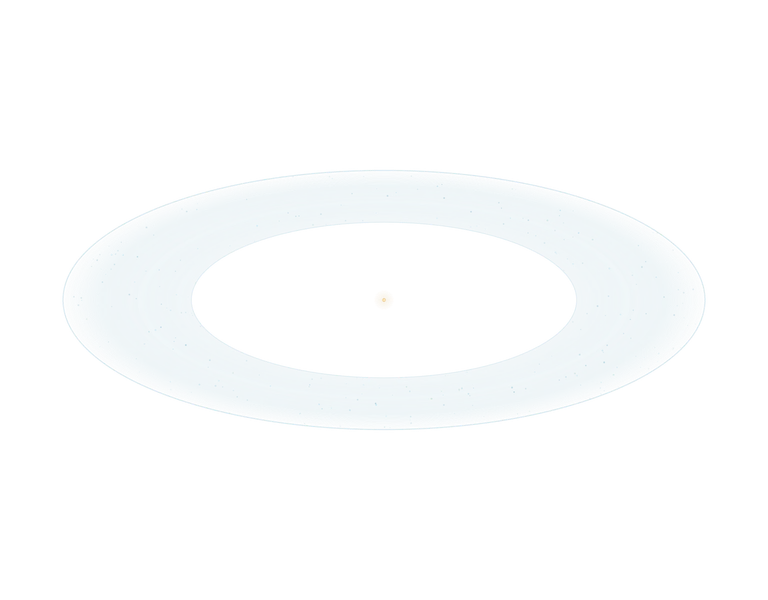
The classical belt occupies approximately the region from 30 to 50 AU from the Sun; 100 AU represents the schematic outer diameter of this region here. The actual belt is thick and structured, with no sharp edge; scattered objects can lie much farther out. Particle density and sizes are exaggerated in the drawing.
Compare the stated dimensions
The comparison uses the number in each fact sheet: altitude, height, diameter, length or distance, depending on the reference. Two values in metres do not necessarily describe the same property.
Source and limitations
Proposed documented order of magnitude; source linked, not individually audited during this session. Model regions and boundaries are highly uncertain.
Classical Kuiper Belt: projected ring with a reference horizontal outer diameter. The band approximately evokes the model's 30–50 AU region; the points are symbolic, with neither sizes to scale nor an observed density. The Sun is a reference drawn out of scale.