
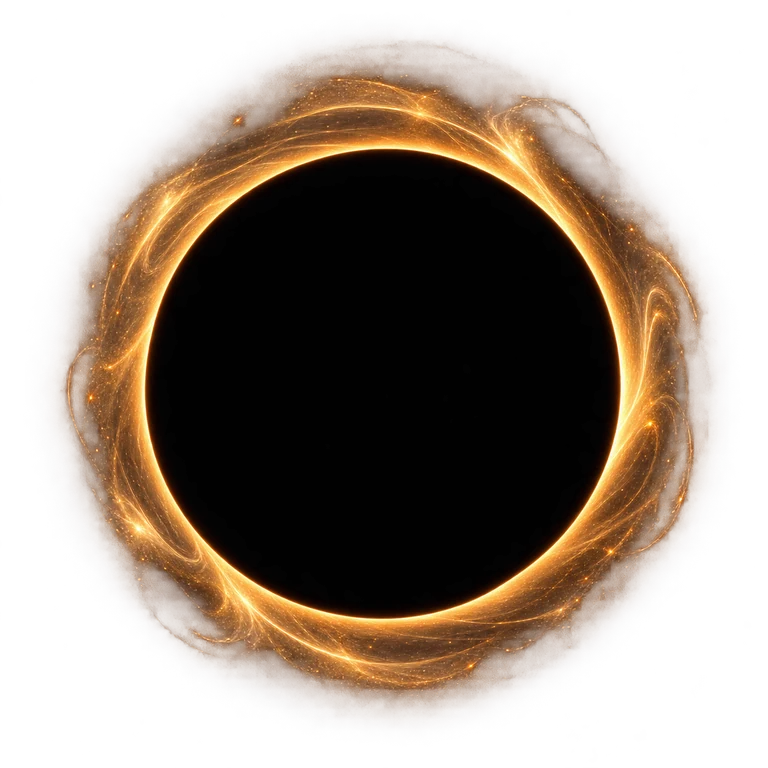
What does this number measure?
Reference mass published in 2024: 32.7 ± 0.82 solar masses. We calculate D = 4 GM☉ × (M/M☉) / c², with nominal GM☉ = 1.3271244 × 10²⁰ m³/s² and c = 299 792 458 m/s. The resulting diameter belongs to a spherical, non-rotating model of the same mass. It is not a direct measurement of the actual horizon or the size of a photographed shadow. The artistic luminous ring is not included in the dimension.
Compare the stated dimensions
The comparison uses the number in each fact sheet: altitude, height, diameter, length or distance, depending on the reference. Two values in metres do not necessarily describe the same property.
Compare with Cygnus X-1 · equivalent horizon (2021) in the explorer →
Source and limitations
Reference mass dated 2024; its published spread is ±0.82 solar masses. The model's diameter is proportional to it. Rotation and optical appearance are excluded from this model, without certifying the actual horizon.
A shared conceptual cross-section of the reference horizons, not a photograph. Only the diameter of the central dark disc follows the non-rotating model's dimension; the outer emitting ring is artistic and excluded from the measurement. This disc is not the shadow observed by the EHT.