
What does this number measure?
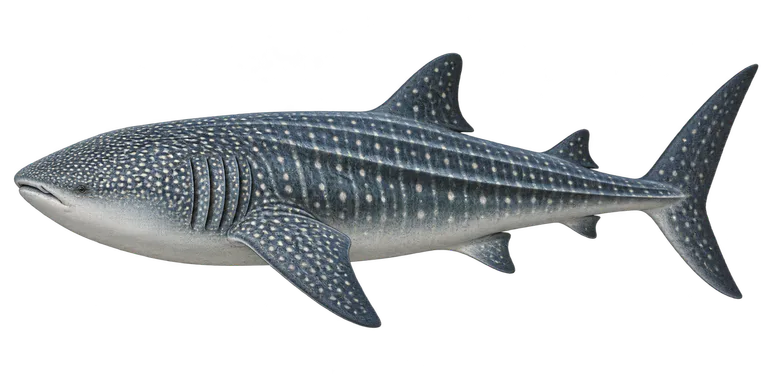
This illustration represents an estimated total length of 18.8 m for a female caught at Veraval, India, on 8 May 2001. Table 1 in Borrell et al. (2011) distinguishes its measured standard length of 15 m from its calculated total length of 18.8 m. Standard length excludes the caudal fin; it should not be confused with total length from snout to tail. This is neither a species average nor a direct measurement of this specimen's full length. Reports close to 20 m exist, but their measurement methods and precision are debated; the exact biological maximum remains unknown. The naturalistic drawing is interpreted and does not reconstruct the individual appearance of the animal studied.
Compare the stated dimensions
The comparison uses the number in each fact sheet: altitude, height, diameter, length or distance, depending on the reference. Two values in metres do not necessarily describe the same property.
Source and limitations
Total length extrapolated from a measured standard length; the study does not provide an uncertainty interval here for this individual estimate. The 18.8 m is not a direct snout-to-tail measurement, an average or a certain maximum size for the species. Reports close to 20 m remain disputed.
Interpreted naturalistic illustration of a whale shark, without reconstructing the reference individual. Total snout-to-tail length calibrated to the estimate of 18.8 m published for the 2001 specimen; artistic anatomy and coloration, not a photograph.