
What does this number measure?
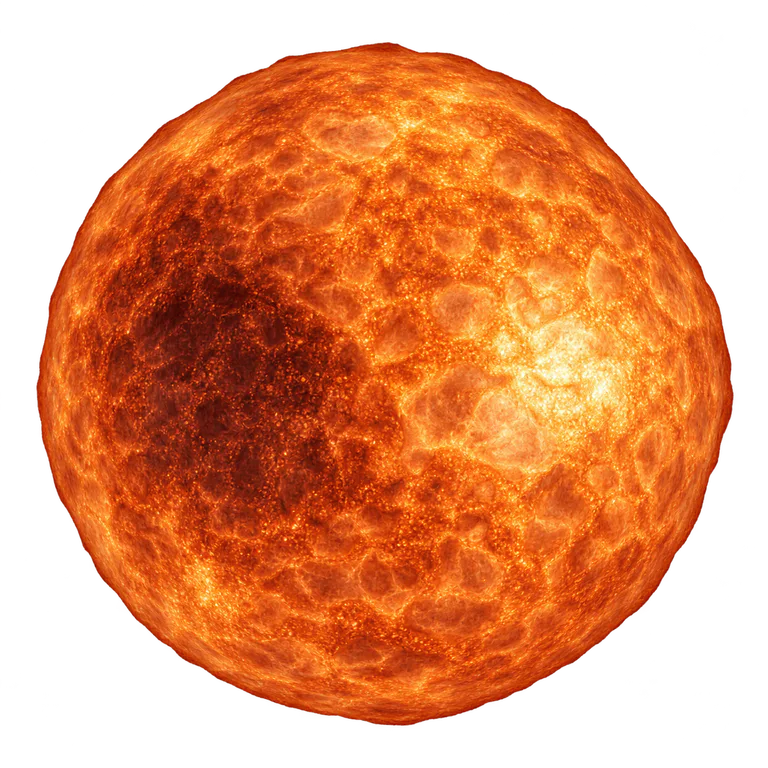
A hypergiant whose surface has been reconstructed using interferometry. The depicted disc represents the diameter, twice the adopted radius of 1100 nominal solar radii (1 nominal solar radius = 695 700 km). The value is a dated estimate, not an established size record. Representative radius of 1 100 ± 44 solar radii in Anugu et al. (2024), dependent on the adopted distance. The images show asymmetries, and the star has undergone significant dimming.
Compare the stated dimensions
The comparison uses the number in each fact sheet: altitude, height, diameter, length or distance, depending on the reference. Two values in metres do not necessarily describe the same property.
Source and limitations
Representative radius of 1 100 ± 44 solar radii in Anugu et al. (2024), dependent on the adopted distance. Images show asymmetries, and the star has undergone significant dimming.
RW Cephei: artistic illustration of a stellar photosphere. A shared generic pattern for comparing diameters, not a photograph or a reconstruction of this star. The value and its uncertainties come from the fact sheet.