
An easy reference to imagine
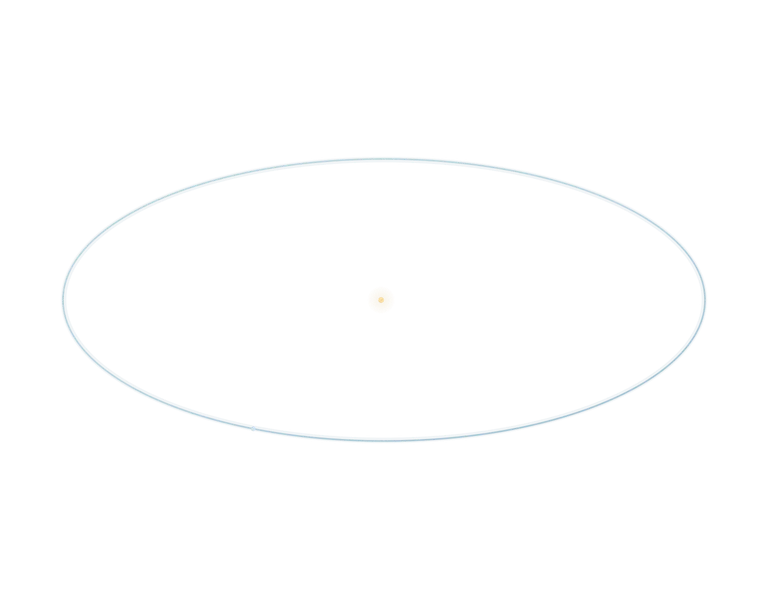
If Neptune’s orbit were 1 cm in diameter…
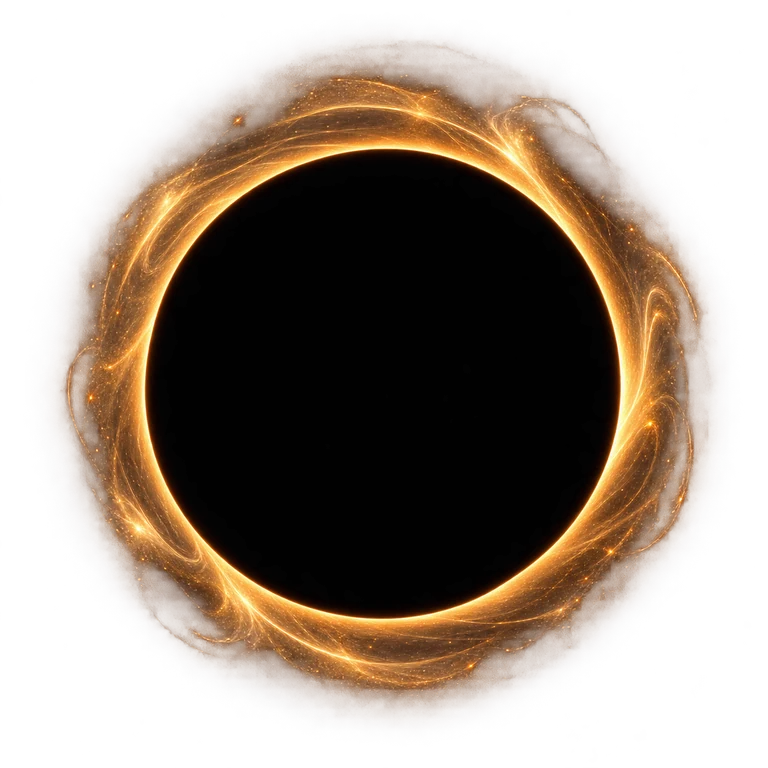
The model horizon diameter would be about 43.3 cm. These are lengths drawn with the same factor, without simulating gravity or trajectories.
The reference mass is 66 billion solar masses, given by NASA in 2023. Diameter is calculated using the non-rotating Schwarzschild model. The estimated mass, rotation and luminous appearance require this calculation to be distinguished from a photograph or a confirmed record.
How does a model horizon compare with planetary orbits?
| Reference | Dimension |
|---|---|
| TON 618 · reference horizon | 389.8 billion km Equivalent Schwarzschild diameter · NASA reference mass 2023 |
| Neptune’s orbit | 9 billion km Approximate diameter |
Reference horizon diameter ÷ orbital diameter: 389.8 billion km ÷ 9 billion km ≈ 43.31. The first comes from a mass model; the second represents an orbit.
Both illustrations use a common factor for the stated dimension. Positions aid reading and do not represent physical separation.
Neptune’s orbit marks the region of the major planets for this comparison. The Solar System does not end at Neptune: the Kuiper Belt and Oort Cloud lie beyond it. TON 618’s model horizon is neither a photographed shadow nor a directly observed boundary.
Check the conventions
TON 618 · reference horizon
The transcript of the NASA visualization published on 1 May 2023 gives a reference mass of 66 billion solar masses for TON 618. The equivalent Schwarzschild diameter is calculated as D = 4 GM☉ × (M/M☉) / c², with nominal GM☉ = 1.3271244 × 10²⁰ m³/s² and c = 299 792 458 m/s. The result is approximately 390 billion kilometres for a spherical, non-rotating model. This is not a direct measurement of the actual horizon or the photographic shadow. The NASA video compares shadows, whose apparent size differs: that size is not used for our horizon diameter. The mass is a documentary estimate, not a certified ranking of the largest black hole. For a familiar reference, Neptune's approximate orbital diameter is about 9 billion kilometres. This reference covers the region of the major planets; it is not the boundary of the entire Solar System.
The mass of a quasar's black hole depends on the estimates and models used; the NASA source does not give a statistical interval for TON 618 here. The 2023 reference is not presented as an exact current mass or a definitively established record. Rotation and luminous appearance are not described by this spherical, non-rotating model. The shadow diameter, an emitting ring and the horizon are not interchangeable.
Neptune’s orbit
A reference for the region of the giant planets. Neptune follows an orbit about thirty astronomical units from the Sun. This reference compares an approximate orbital diameter, about twice that distance.
Catalogue order of magnitude; a source is provided, but this measurement has not been individually audited.
Choose another reference
Keep a common factor to compare both dimensions, or open a clearly identified close-up at a different scale.