
What does this number measure?
The transcript of the NASA visualization published on 1 May 2023 gives a reference mass of 66 billion solar masses for TON 618. The equivalent Schwarzschild diameter is calculated as D = 4 GM☉ × (M/M☉) / c², with nominal GM☉ = 1.3271244 × 10²⁰ m³/s² and c = 299 792 458 m/s. The result is approximately 390 billion kilometres for a spherical, non-rotating model. This is not a direct measurement of the actual horizon or the photographic shadow. The NASA video compares shadows, whose apparent size differs: that size is not used for our horizon diameter. The mass is a documentary estimate, not a certified ranking of the largest black hole. For a familiar reference, Neptune's approximate orbital diameter is about 9 billion kilometres. This reference covers the region of the major planets; it is not the boundary of the entire Solar System.
Compare the stated dimensions
The comparison uses the number in each fact sheet: altitude, height, diameter, length or distance, depending on the reference. Two values in metres do not necessarily describe the same property.
Source and limitations
The mass of a quasar's black hole depends on the estimates and models used; the NASA source does not give a statistical interval for TON 618 here. The 2023 reference is not presented as an exact current mass or a definitively established record. Rotation and luminous appearance are not described by this spherical, non-rotating model. The shadow diameter, an emitting ring and the horizon are not interchangeable.
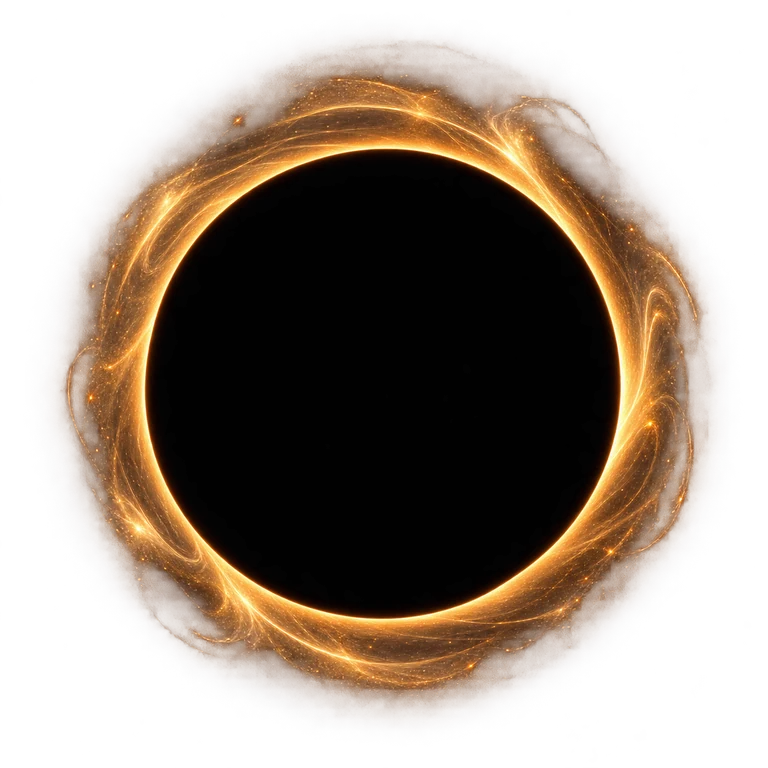
Shared conceptual cross-section, interpreted and not photographic. For TON 618, only the central dark disc is calibrated to the equivalent Schwarzschild diameter of the NASA 2023 reference mass; the bright ring is artistic and excluded from the measurement. This is not an observed shadow.