
What does this number measure?
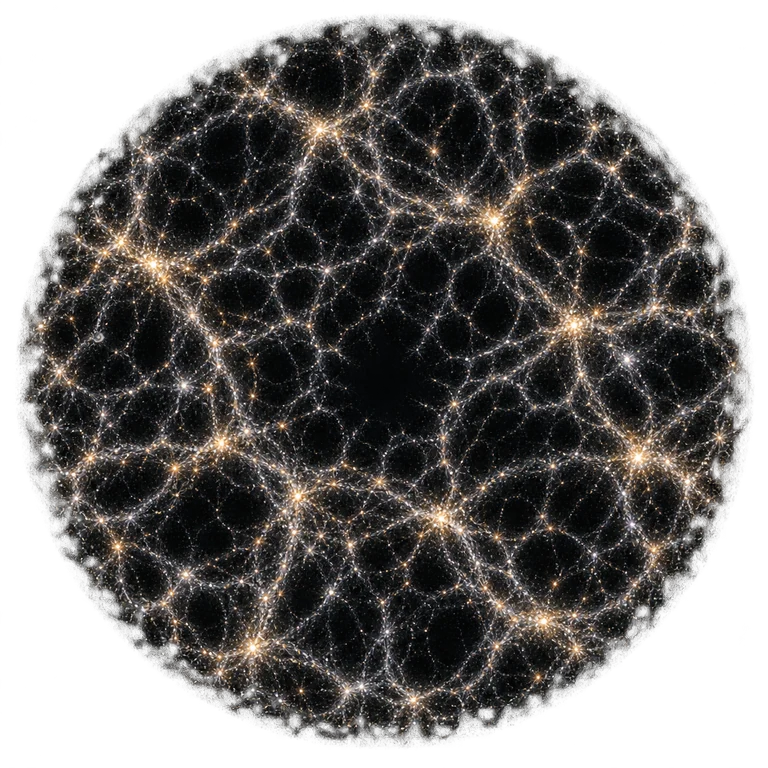
The region whose light can reach us today. The expansion of space explains why its present diameter is far greater than 13.8 billion light-years. Our observation point is at the centre of our observable Universe: this region is defined from our position. This does not make Earth the centre of the entire Universe. The observable Universe is not necessarily the whole Universe, and its horizon is not a physical wall.
Compare the stated dimensions
The comparison uses the number in each fact sheet: altitude, height, diameter, length or distance, depending on the reference. Two values in metres do not necessarily describe the same property.
Source and limitations
Catalogue order of magnitude; a source is provided, but this measurement has not been individually audited.
Observable universe: a conceptual cross-section centred on our observing point. Illustrative network, not a photograph; the horizon is neither a wall nor the edge of the entire Universe.