
How can a complete chip be 120 times shorter than an Intel 8086?
| Reference | Dimension |
|---|---|
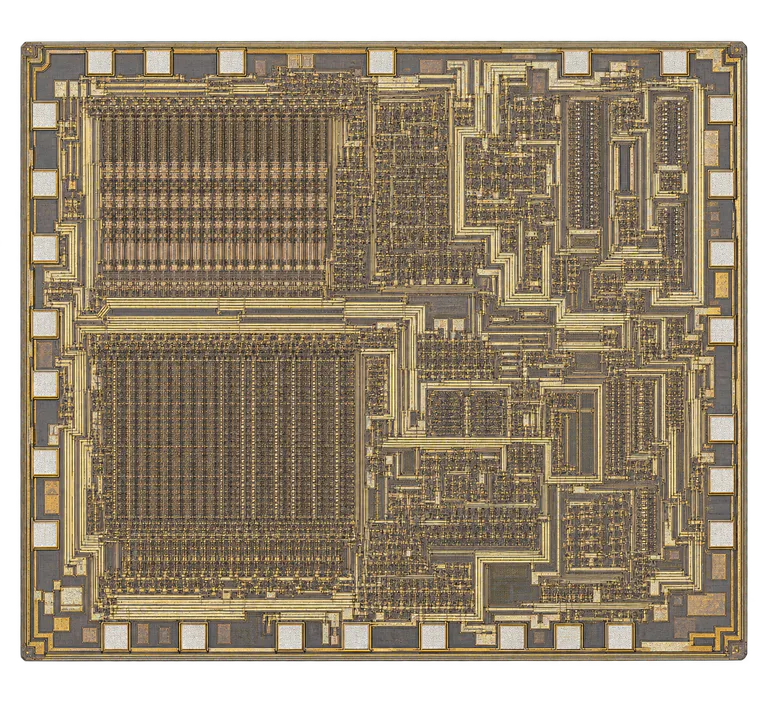
| Intel 8086 · bare die | 6 mm longer side of the die ≈ 6 mm |
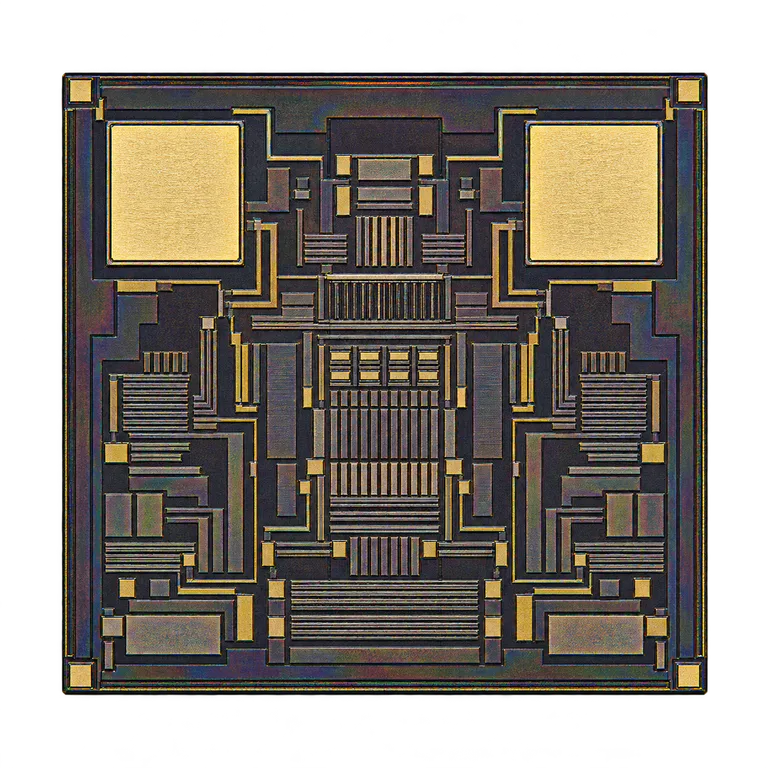
| Hitachi · 50 µm RFID chip | 50 µm side of the entire die ≈ 50 µm |
Calculation: 6 mm ÷ 50 µm, after conversion into the same unit. The ratio calculated from the catalogue data is about 120.
Both illustrations use a common factor for the stated dimension. Positions aid reading and do not represent physical separation.
The 50 micrometres describe the demonstrator’s silicon, not a self-contained RFID system: antenna and reader remain external. The ratio of 120 describes neither computing speed, power nor area; the 8086 silicon is not square.
Check the conventions
Intel 8086 · bare die
1978Commercial release
The bare Intel 8086 die measures about 6 × 5.5 mm. We compare its longer side. A newer die can be larger while containing more transistors: shrinking fabrication features does not require the processor's total area to shrink.
Documentary source linked; access was blocked by the proxy during this session. Approximate value not checked again online.
Hitachi · 50 µm RFID chip
2007Demonstration
In 2007, Hitachi presented a tiny identification circuit approximately 0.05 × 0.05 mm, or 50 × 50 µm. The entire silicon chip is represented here. The antenna and reader required for operation are not included in this dimension. This is a demonstration of miniaturization for a circuit with limited functionality, not a 50 µm general-purpose computer. The chip's size does not give the size of its transistors.
Linked source not consulted: the proxy returns CONNECT403 for this domain during this session. Approximate historical value to be checked again in an accessible source; no measurement of the illustration. Its status as a demonstrator and the exclusion of the antenna are essential to the comparison.
Choose another reference
Replace an object in the explorer, keep the common scale factor and try predicting the new ratio before reading it.
Open the comparison →