
How many Earths fit in the Sun?
| Reference | Dimension |
|---|---|
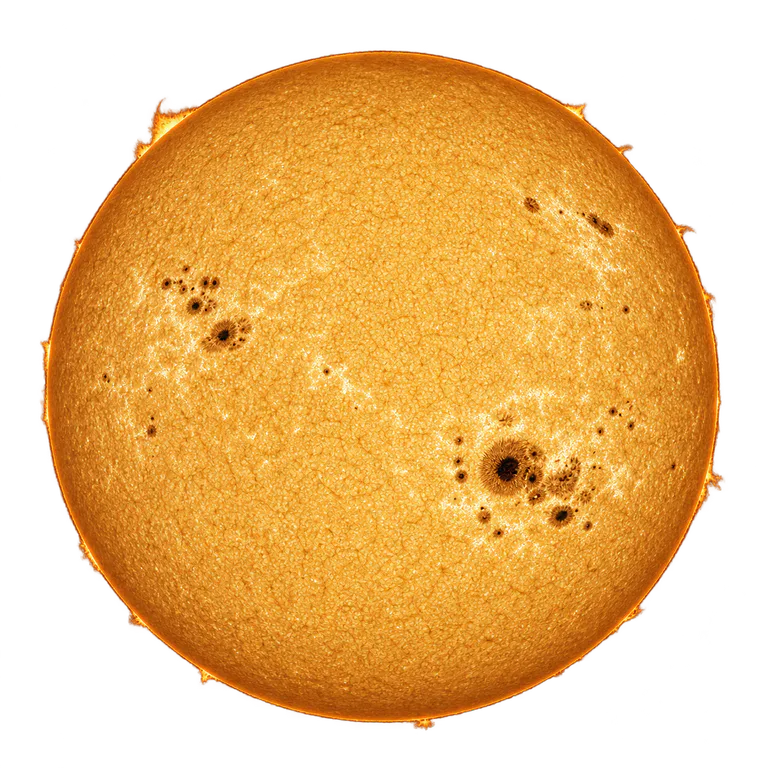
| Sun | 1,392,700 km Mean diameter ≈ 1 393 000 km |
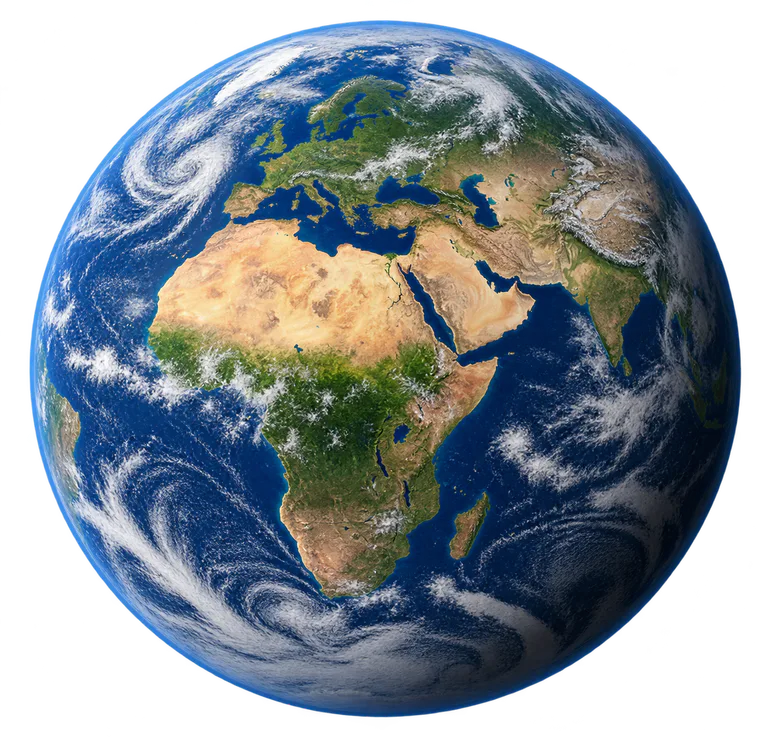
| Earth | 12,742 km Mean diameter ≈ 12 740 km |
Calculation: 1,392,700 km ÷ 12,742 km, after conversion into the same unit. The ratio calculated from the catalogue data is about 109.3.
Both illustrations use a common factor for the stated dimension. Positions aid reading and do not represent physical separation.
Equivalent volume does not tell us how many identical small spheres can be stacked inside a large one: a stack leaves gaps.
Diameter or volume: two different answers
By diameter: about 109.3 Earth diameters across the Sun’s diameter.
In a sphere model: the volume ratio is (109.3)³, or about 1,310,000 Earth volumes.
This model does not describe how many spheres could actually be stacked inside the Sun. It compares equivalent volumes; densities, masses and packing gaps are not calculated.
Check the conventions
Sun
The diameter concerns the photosphere, the apparent luminous surface. The solar corona extends much farther.
Approximate catalogue reference; a source is provided, but the measurement has not been individually audited.
Earth
Mean diameter calculated from the volume-equivalent radius in the NASA/JPL table. Rings and the outer atmosphere are excluded.
Approximate catalogue reference; a source is provided, but the measurement has not been individually audited.
Choose another reference
Replace an object in the explorer, keep the common scale factor and try predicting the new ratio before reading it.
Open the comparison →